 ?>
?>
 By
By A Practical Payroll Guide for UK Businesses
Payroll is one of the most important responsibilities for any employer.
Your employees expect to be paid accurately and on time, while your business must meet its PAYE, National Insurance, pension and reporting obligations.
As your business grows, you may face an important question:
Should we manage payroll in-house or outsource it to a professional payroll provider?
Both options have advantages and disadvantages.
The right choice depends on the size of your workforce, complexity of your payroll, available staff, technology, budget and the level of compliance support your business requires.
At TT Accountancy Services (TTAS), we provide payroll and accounting support to UK businesses, helping employers manage payroll accurately and efficiently.
What Is In-House Payroll?
In-house payroll means your business manages its payroll internally.
You may have:
- An HR employee
- Finance staff
- An accounts team
- A dedicated payroll administrator
responsible for calculating and processing employee pay.
Your internal team would typically handle:
- Employee salaries
- PAYE
- National Insurance
- Pension contributions
- Statutory payments
- Payslips
- HMRC submissions
- Payroll records
What Is Outsourced Payroll?
Outsourced payroll means your business appoints an external accountant or payroll provider to manage some or all of its payroll responsibilities.
The provider may handle:
- Payroll calculations
- Payslips
- PAYE
- National Insurance calculations
- RTI submissions
- Pension administration
- Statutory payments
- Payroll reports
- Year-end payroll processes
The exact service depends on the provider and your agreement.
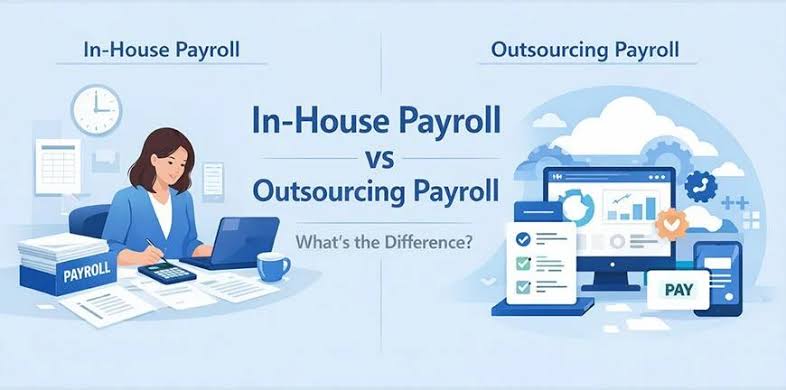
In-House Payroll vs Outsourcing Payroll
| In-House Payroll | Outsourced Payroll |
|---|---|
| Managed by employees | Managed by external professionals |
| Greater direct control | Less internal administration |
| Requires payroll expertise | Access to specialist expertise |
| Requires payroll software | Provider usually supplies or uses appropriate software |
| Staff training required | Provider manages technical payroll processes |
| Can become expensive as complexity grows | Predictable service costs may be easier to budget |
| Internal staff have access to sensitive data | Data is shared with a third-party provider |
Advantages of In-House Payroll
1. Direct Control
Your employees manage payroll internally, allowing you to maintain direct oversight of the process.
2. Immediate Access to Payroll Information
Your finance or HR team can access payroll information without relying on an external provider.
3. Integration With Internal Systems
Large organisations may already have HR and accounting systems that integrate with their payroll processes.
4. Potential Cost Benefits for Larger Businesses
For businesses with a large workforce and established payroll departments, managing payroll internally may be cost-effective.
However, this depends on staffing, software, training and the complexity of the payroll.
Disadvantages of In-House Payroll
1. Payroll Requires Specialist Knowledge
UK payroll involves more than simply calculating salaries.
Your team needs to understand relevant rules covering:
- PAYE
- National Insurance
- Workplace pensions
- Statutory payments
- Tax codes
- Student loans
- Benefits
- Real Time Information
- Payroll reporting
Payroll rules can also change, meaning staff need to stay up to date.
2. Staff Training Costs Money
Payroll employees need regular training.
If your payroll administrator leaves, your business may suddenly face a knowledge gap.
3. Payroll Errors Can Be Costly
Errors can result in:
- Incorrect employee pay
- Incorrect deductions
- HMRC issues
- Employee complaints
- Additional administrative work
- Compliance problems
4. Payroll Creates Additional Administrative Work
Processing payroll takes time.
As your workforce grows, payroll administration can become increasingly demanding.
Advantages of Outsourcing Payroll
1. Access to Payroll Expertise
A professional payroll provider handles payroll regularly and keeps up with relevant requirements.
This can reduce the pressure on your internal team.
2. Saves Time
Instead of spending hours processing payroll, your employees can focus on:
- Customers
- Sales
- Operations
- Finance
- Business growth
3. Helps Reduce Payroll Errors
Professional payroll providers have established processes and checks designed to improve accuracy.
No system eliminates all errors, but professional oversight can reduce the risk.
4. Supports HMRC Compliance
Payroll providers can help businesses manage requirements such as:
- PAYE
- National Insurance
- Real Time Information submissions
- Statutory payments
- Payroll records
This can help employers stay organised and meet their reporting obligations.
5. Scalability
Outsourced payroll can be particularly useful when your workforce is growing.
Instead of hiring additional payroll staff, you can often increase the scope of your payroll service.
What Does Payroll Outsourcing Cost?
There is no universal payroll outsourcing price.
Costs can depend on:
- Number of employees
- Payroll frequency
- Number of pay runs
- Pension administration
- Statutory payments
- Payroll complexity
- Number of locations
- Additional reporting requirements
A small business with five employees will have very different payroll requirements from a company employing 200 people.
When comparing providers, don’t look only at the headline price.
Consider what is actually included.
Is Outsourcing Payroll Safe?
Payroll contains highly sensitive information.
This can include:
- Employee names
- Addresses
- Salaries
- Bank details
- National Insurance information
- Tax information
If you outsource payroll, you should ensure that your provider has appropriate data protection, security and confidentiality procedures.
You should also establish clearly:
- Who has access to payroll information
- How information is transferred
- How data is stored
- How long records are retained
- What happens if the relationship ends
When Should You Outsource Payroll?
Outsourcing may be worth considering if:
Your business is growing
Payroll becomes more complicated as employee numbers increase.
You don’t have payroll expertise
If nobody in your organisation has specialist payroll knowledge, outsourcing may reduce risk.
Payroll takes too much time
If payroll is distracting your finance or HR team from more important work, outsourcing can free up resources.
You have complex payroll
Multiple tax codes, pensions, benefits, statutory payments or different pay structures can make payroll more difficult.
Your payroll administrator is leaving
Outsourcing can provide continuity while you restructure your internal processes.
When Might In-House Payroll Be Better?
In-house payroll may be appropriate when:
- You have a large finance or HR team
- Payroll is highly integrated with internal systems
- You have specialist payroll expertise
- You require extensive internal control
- Your payroll is sufficiently large to justify dedicated staff
- You have the resources to maintain payroll knowledge and software
A Hybrid Payroll Model
Businesses don’t always have to choose one extreme.
A hybrid approach can involve keeping certain responsibilities internally while outsourcing technical payroll processing.
For example:
Your business handles:
- Employee information
- New starters
- Leavers
- Holiday information
- Internal approvals
Your payroll provider handles:
- Payroll calculations
- PAYE
- National Insurance
- RTI submissions
- Payslips
- Payroll reports
This can provide a balance between internal control and external expertise.
Questions to Ask Before Choosing a Payroll Provider
Before outsourcing payroll, ask:
- How much does the service cost?
- What exactly is included?
- How is payroll information transferred?
- How is employee data protected?
- Who handles HMRC submissions?
- How are payroll errors corrected?
- What happens if payroll information is submitted late?
- Can the provider handle workplace pensions?
- Can the service scale as employees are added?
- Will I have a dedicated contact?
The cheapest provider isn’t necessarily the best provider.
Common Payroll Mistakes Businesses Should Avoid
❌ Treating payroll as simple administration
Payroll involves significant compliance responsibilities.
❌ Leaving payroll until the last minute
Late processing creates unnecessary pressure.
❌ Failing to update employee information
Changes in tax codes, salaries, bank details or personal circumstances need to be handled correctly.
❌ Ignoring pension obligations
Workplace pension responsibilities should be incorporated into your payroll processes.
❌ Not keeping adequate records
Employers need to maintain appropriate payroll records.
How TT Accountancy Services Can Help
At TT Accountancy Services, we provide payroll support designed to reduce the administrative burden on UK employers.
Our payroll services can include:
✔ Payroll Processing
✔ PAYE Calculations
✔ National Insurance
✔ Payslips
✔ Real Time Information (RTI) Support
✔ Workplace Pension Support
✔ Statutory Payments
✔ Payroll Reports
✔ Payroll Record Management
✔ Year-End Payroll Support
We can work with small businesses, growing SMEs and employers that need reliable payroll administration.
There is no universally correct answer to the question:
“Is in-house payroll better than outsourcing?”
The right option depends on your business.
For larger organisations with dedicated payroll teams, in-house processing may make sense.
For small and growing businesses, outsourcing can provide access to specialist knowledge while reducing administrative workload.
The most important consideration is not simply cost.
Your payroll system needs to be accurate, secure, timely and compliant.
Need Reliable Payroll Support?
TT Accountancy Services helps UK businesses manage payroll, accounting, bookkeeping and tax obligations.
If payroll is taking too much time or you’re concerned about payroll compliance, speak to TTAS about an outsourcing solution tailored to your business.